
HX-MDAO-TP
Validity-gated engineering results with reproducible signed evidence.
The type system ties provenance to each result’s validity state. Results distinguish supported validity, unsupported validity, unknown support and failure to produce a converged result.
Evaluate HX-MDAO-TP for your team
- Who it serves
- Engineering teams responsible for coupled multidisciplinary analysis and design optimization.
- When to evaluate
- A design decision depends on interacting discipline models, and reviewers need to inspect convergence, validity and the evidence supporting acceptance.
- Outcome to establish
- Analysis or optimization results with explicit convergence and validity states, signed provenance and formal certificates for specified invariants.
- Deployment
- Scoped pilot
- Evidence to review
- Validity status, convergence, acceptance results, provenance and formal certificates for specified invariants
- Commercial starting point
- Scope a pilot with your discipline models and reference cases. Agree model integration, numerical tolerances, validity policy and acceptance evidence before broader deployment.
Engineering console
Model, Operate, Prove, Compare. The console renders the engineering system without interpretation drift, and treats the evidence package as the claim. Trust states are engine-issued; the browser cannot upgrade them.
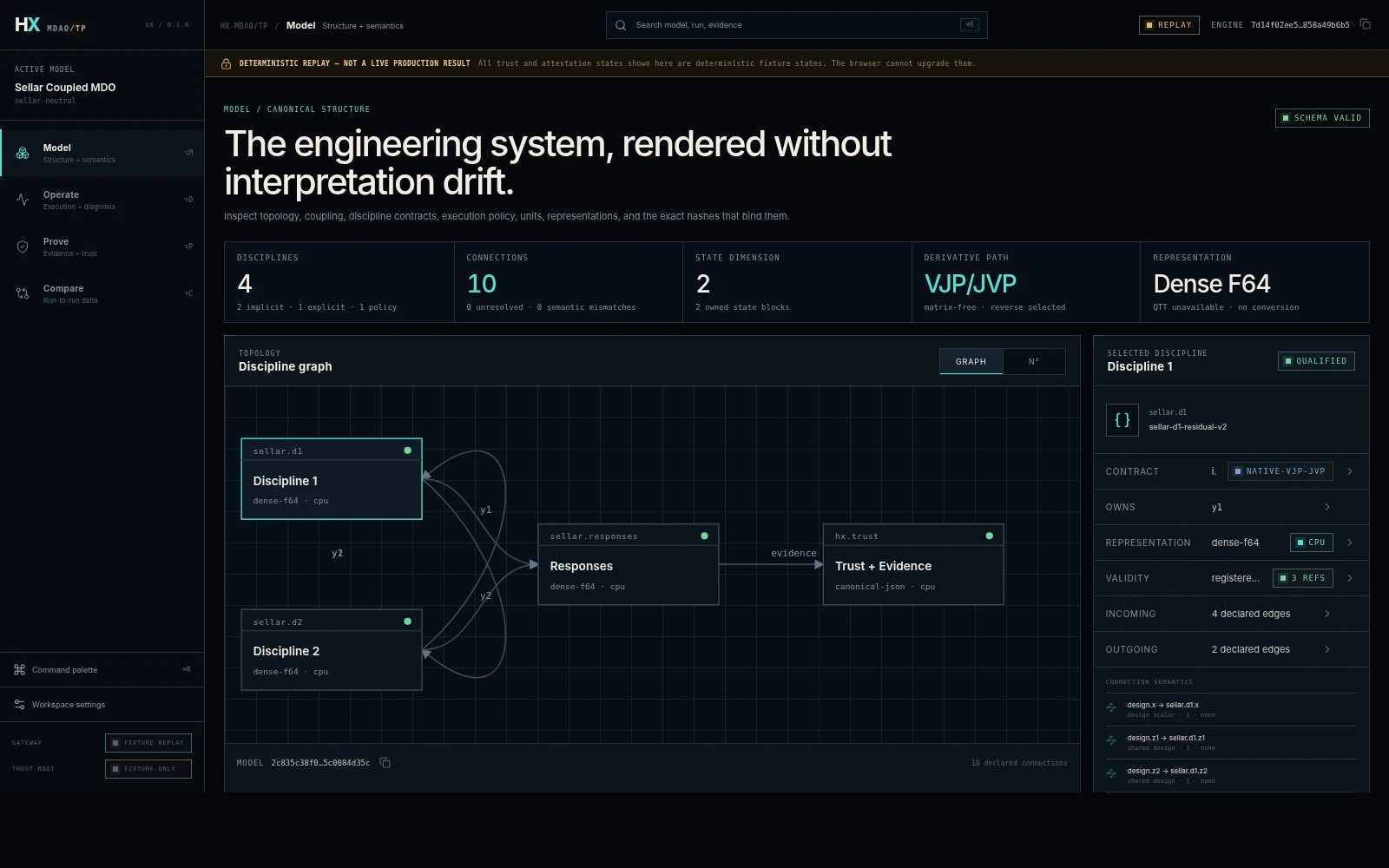
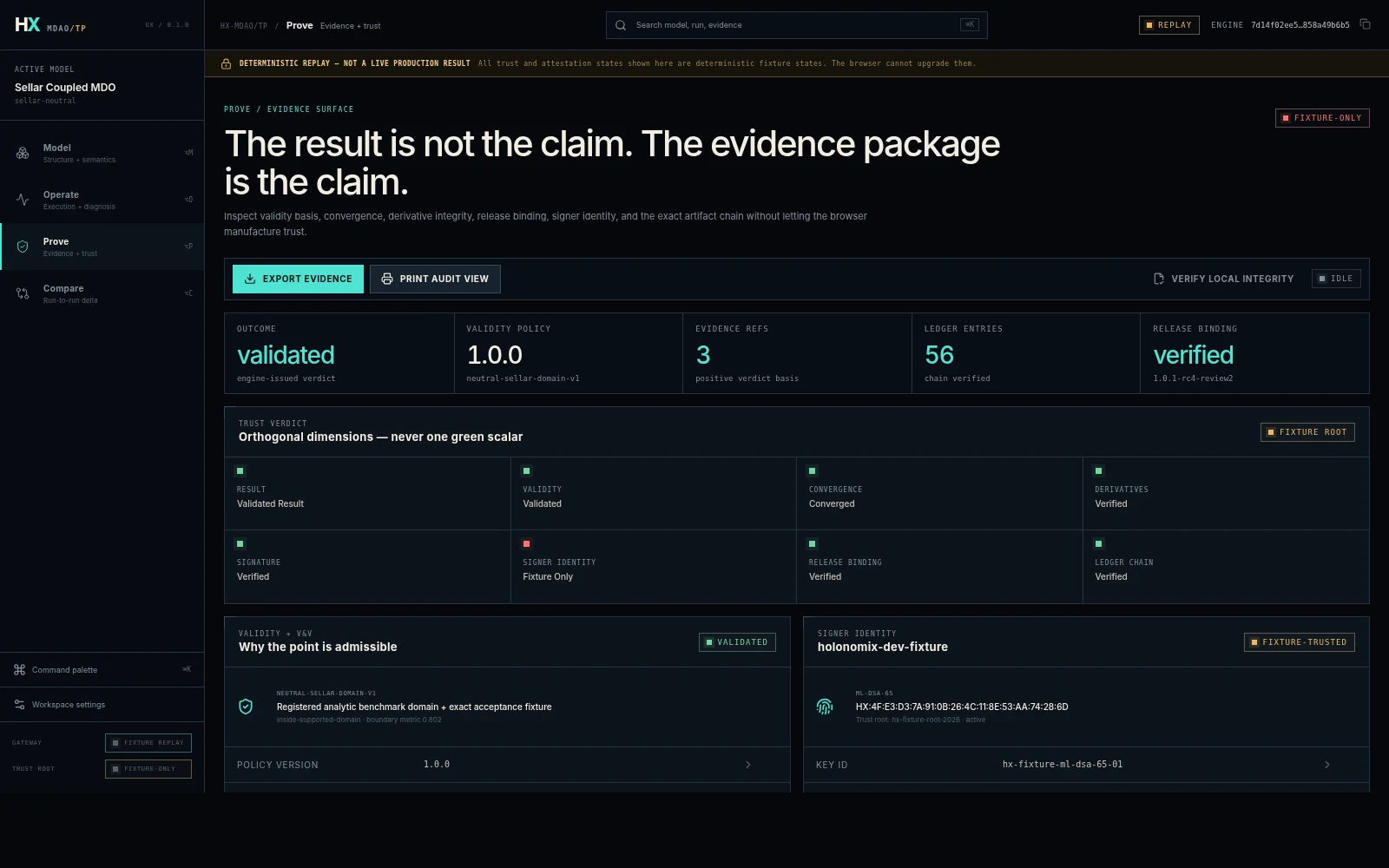
The multidisciplinary design engine you can put in front of a certifier.
HX-MDAO-TP is an engine for multidisciplinary design analysis and optimization with a trust and provenance plane woven into its type system. It couples your disciplines, builds representation-aware response surfaces across topology changes and tested validity regions, drives the optimizer, propagates uncertainty, and returns a result stamped with its validity domain and sealed with a post-quantum signature.
Each numerical result carries its validity decision and supporting policy. A registered policy with identified validation evidence is required to establish support; a point inside an anchor envelope is not automatically validated.
Compression and certification operate independently
Compressed representation with bounded-rank surrogates
A self-authored tensor-train / QTT substrate represents fields, operators, and Jacobians in compressed form and differentiates through them, delivering bounded-rank surrogates for high-interaction-order quantities where the tested spectral baselines produced no qualifying result.
Validity-gated results with reproducible signed evidence
Numerical output backed by a provable, attested trust and provenance plane: results signed with ML-DSA at commit boundaries, recorded in an append-only chained ledger, and verifiable by a third party with the matching verifier and an independently pinned signer fingerprint.
A registered validity policy can mark a result VALIDATED. Unsupported points are NOT_VALIDATED; unknown support produces ABSTAIN. A model-domain failure or an unconverged solve produces NO_RESULT. Signed evidence preserves the decision and its supporting policy.
v1.0
Gate-verified end to end: a full acceptance suite passing on both CPU and NVIDIA A100, dense-CPU-versus-A100 agreement to floating-point round-off, a kernel-checked Lean4 certificate, and a signed, third-party-reproducible provenance manifest over the shipped tree. Deploys as a hardened, reproducible image and supports offline operation. The deployment configuration determines which network services are exposed.
The pilot connects your discipline models to a declared validity policy and verifies the resulting signed evidence.
Preparing an MDAO pilot
Start with a representative coupled problem and reference cases whose expected behavior is already understood. The pilot should establish both the numerical result and the evidence needed to accept it.
Model interface
Identify the discipline models, shared design variables, units, bounds, constraints and coupling relationships. The Julia evaluation interface accepts a client solve function, a model-domain predicate and an explicit validity policy. Supply convergence status with the numerical output.
Agree any adapter or model-exchange work against the versions supplied for the pilot.
Reference exercise
The supplied Sellar quickstart demonstrates a coupled problem with validation anchors. It compares an identified anchor under a registered policy, an in-envelope point with unknown support and an unsupported point. These exercise VALIDATED, ABSTAIN and NOT_VALIDATED handling before customer models are introduced.
Acceptance evidence
Specify numerical tolerances, convergence criteria, justified validation anchors and the evidence behind the validity policy. Check an unconverged case as well as accepted results. Export the signed audit and verify it using an independently established signer fingerprint.
Request the model-interface material and matching example with the pilot scope.
Define the analysis and optimization scope
Multidisciplinary analysis and optimization with coupled models, shared constraints, declared validity domains and acceptance criteria.
Inputs
Discipline models, design variables, constraints, reference cases, and acceptance criteria.
Outputs
Convergence and validity records, accepted analysis or optimization results, provenance and formal certificates for specified invariants.
Limits
Formal proof applies to specified invariants. Model validity and empirical accuracy require their own evidence.
Availability: Scoped pilot.